Cosine similarity
Measures proximity between a brand and each strategic territory.[6]
Whitepaper · Semantic Coherence
How Brand Spec turns strategy into a structured identity object, maps it into semantic space, and tests whether it resolves into a coherent brand position.
Brand Spec can create brand identities that are semantically measurable and strategically coherent, without exposing the internal diagnostic model.
The Problem
A positioning line feels sharp or soft. A voice feels premium or generic. A brand book feels internally consistent, or it does not. These judgments matter, but they are difficult to inspect — they depend on taste, experience, and the room in which the work is reviewed.[1][2]
Most brand systems contain values, voice principles, audience descriptions, positioning statements, creative guardrails, and approved language. In practice those components are interpreted manually by designers, writers, marketers, agencies, and AI systems. Every interpretation introduces drift.
The missing layer is not more guidelines. It is measurement.
The Method
The analysis maps brand identities and reference patterns into the same semantic space. Each identity is encoded as a high-dimensional vector[6][7] that reflects recurring strategic signals: relationship mode, cultural tension, authority style, narrative posture, commercial behavior, voice, and boundaries.
Once encoded, the identity is compared against a library of reference patterns rooted in established brand-archetype theory.[4][5] These patterns are not exposed as labels in the public-facing product — they operate as a diagnostic layer, a way to understand the gravitational forces around a brand without forcing it into a simplistic type.
Measures proximity between a brand and each strategic territory.[6]
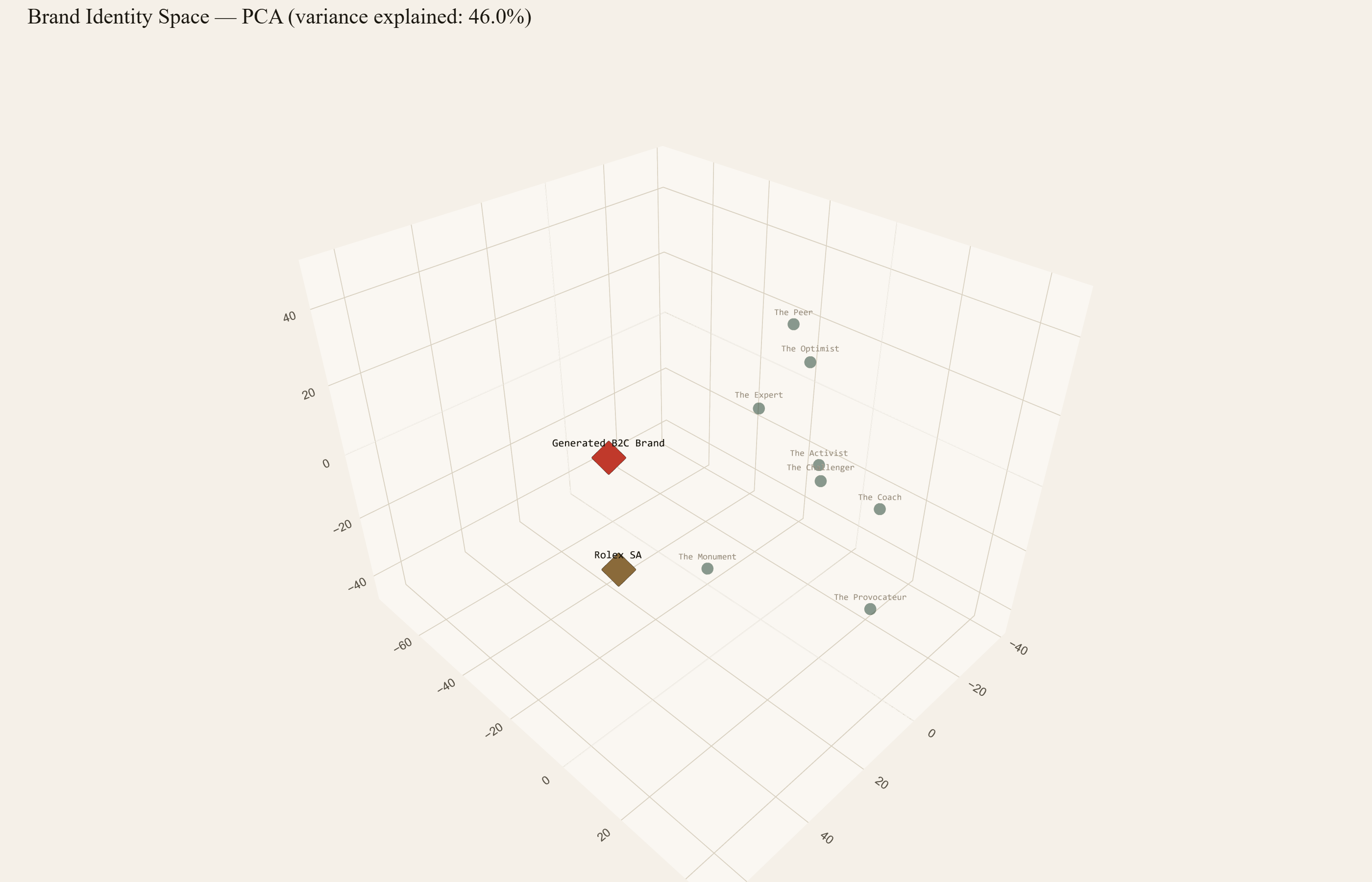
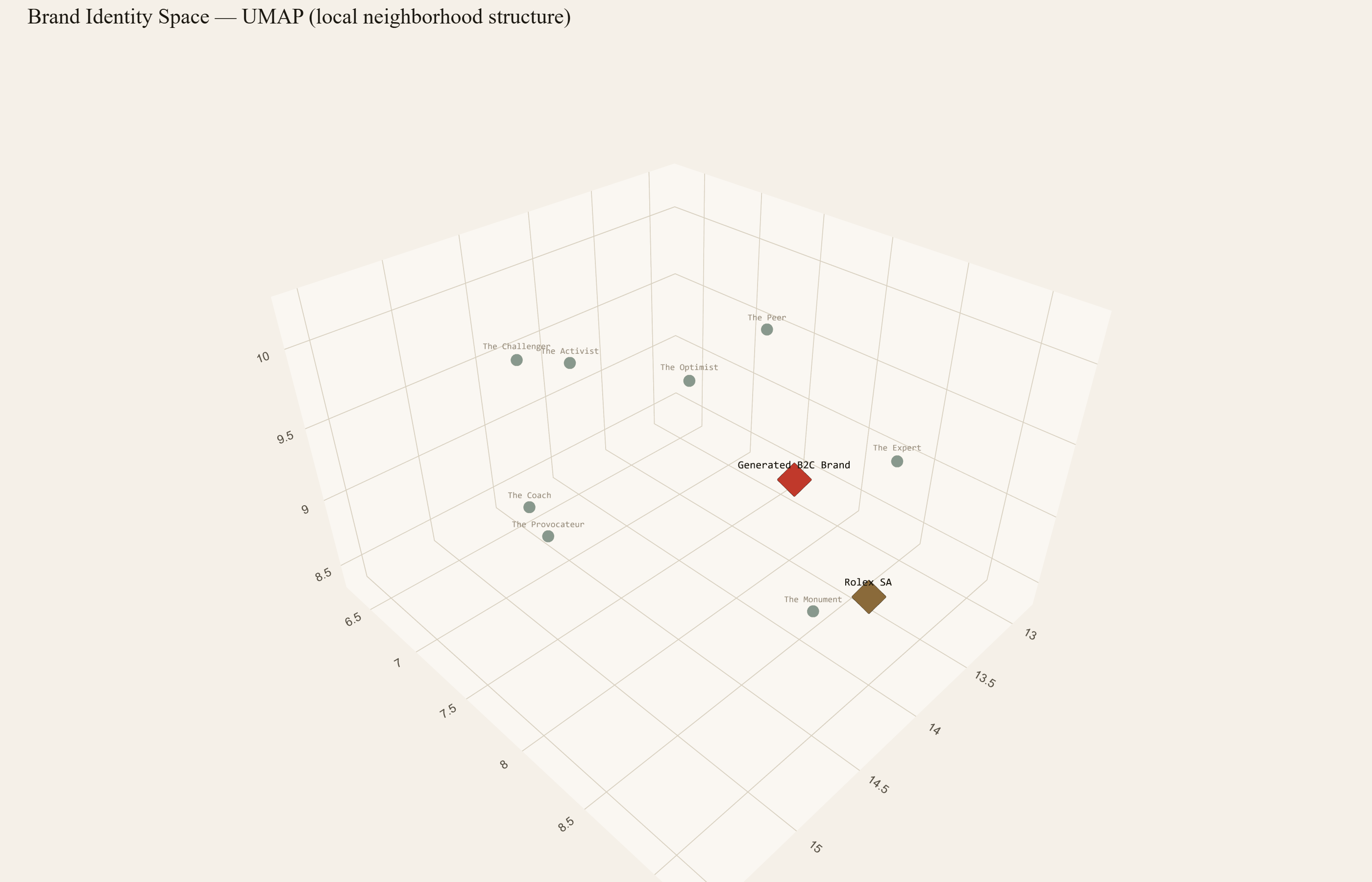
Show broad variance and local neighborhood structure across the identity space.
The question is not "what type is this brand?" The question is "does this identity occupy a coherent strategic position?"
Calibration Case
Rolex is a useful reference brand because its identity is unusually stable. Across culture, commerce, and product experience, Rolex is associated with permanence, precision, achievement, trust, and inherited excellence. It is not merely a luxury watch brand — it is mastery made durable.
The important point is not that Rolex is "classified." The important point is that its identity concentrates around a coherent center — it does not scatter across unrelated territories, and does not depend on one slogan or one campaign.
Generated Brand
The same analysis can be applied to a B2C brand generated through Brand Spec. This brand is not named here because the point is not the brand itself — the point is to test whether Brand Spec can create an identity that is strategically coherent before it becomes a public-facing brand system.
Where Rolex is sharply anchored, this brand forms a blended identity — it sits near territories associated with practical change, category tension, peer-level accessibility, useful expertise, and everyday improvement.
This is not a weaker form of coherence. It is a different form — practical transformation delivered through accessible, everyday behavior.
Embedded Analysis
PCA and UMAP provide complementary views of the same identity space: PCA for broad orientation, UMAP for neighborhood structure. Both are plotted against the same 8 archetype territories, with Rolex and the generated B2C brand marked as diamonds.
Two Kinds of Coherence
A dominant center of gravity. Rolex is the clearer example — its meaning collects around permanence, mastery, authority, and durable status, with adjacent signals supporting that center rather than competing with it. Useful for brands that need to feel inevitable, established, institutional, premium, or culturally immovable.
Several nearby signals forming a composite identity. The generated B2C brand combines usefulness, accessibility, improvement, and category challenge without any one idea cancelling the others. Useful for brands that need to move across moments: onboarding, retention, social content, community.
Why This Matters
A structured brand system can produce copy, design rules, content guidance, campaign language, and governance constraints. But before those outputs scale, teams need to know whether the underlying identity is coherent. The analysis creates a validation layer:
This matters especially for AI-assisted brand systems. Generative tools are very good at producing plausible language. Plausibility is not the same as identity — a brand system needs continuity, constraint, and memory.
What We Can Claim
It does not claim that brand identity is fully solved by statistics. It does not claim that a brand can be reduced to a fixed type. It does not expose internal pattern names as the product.
Instead, it shows that a brand can be represented as a structured identity object, mapped into semantic space, and evaluated for proximity to meaningful strategic territories — moving brand work from "this feels right" toward "this has a coherent center, and we can show where it lives."
The Stage For Brand Spec
Brand Spec gives a brand a machine-readable identity that is still legible to humans — who the brand is, what it believes, how it speaks, what it refuses, and how it should behave across contexts. The measurement layer adds confidence: before the brand becomes a website, a campaign, an onboarding flow, or an AI content system, Brand Spec can ask whether the identity itself is coherent.
References